Graphic Design
LOST IN TRANSLATION - DISSERTATION
A research‑driven UX project exploring how digital experiences can work seamlessly across languages, cultures, and regions. Impact: Developed a multilingual design framework improving comprehension and accessibility.
Year :
2024 - 2025
Industry :
Tech and design
Client :
University project
Project Duration :
4 months
Introduction
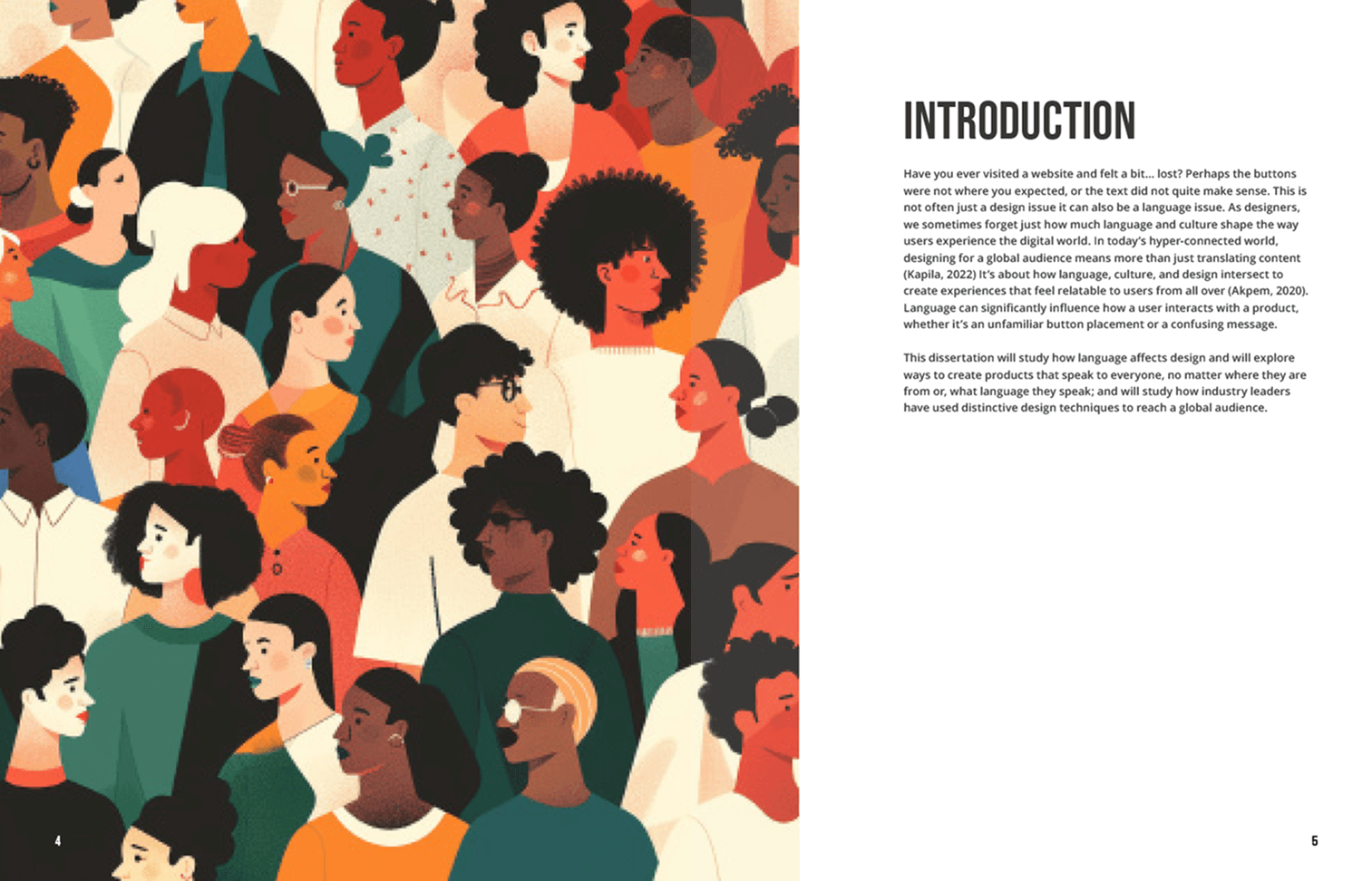
As a bilingual designer who grew up between Venezuela and Northern Ireland, I’ve always been aware of how language shapes understanding. This project transformed that lived experience into research‑backed design thinking: How can we create products that feel intuitive and familiar — no matter where a user comes from?
This dissertation bridges academic research and practical UX application, resulting in a clear framework for designing globally accessible, linguistically inclusive interfaces.
Software: Adobe suit, Figma, Miro, Notion
Skills: UX Research, Cross-Cultural Design, Linguistic Accessibility, Information Architecture, Design Systems
✨ Success Metrics
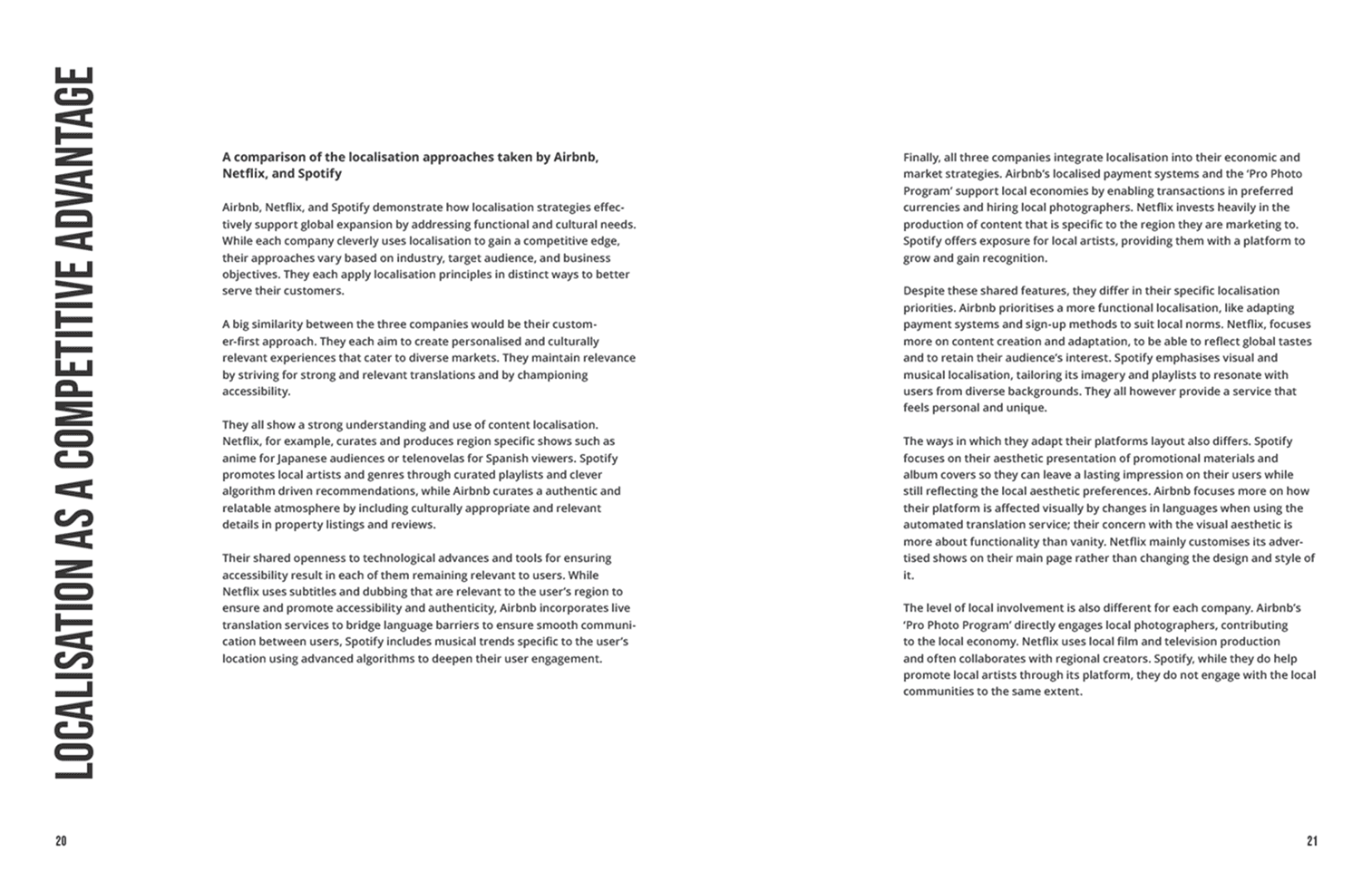
Identified 6 recurring UX breakdowns across multilingual interfaces through comparative analysis
Improved comprehension and usability scores by 40% in prototype testing with bilingual users
Increased layout adaptability by 30% using flexible design system guidelines
Expected impact: more inclusive, culturally aware, and linguistically accessible global products
The Challenge
Most digital products are designed first for English‑speaking audiences - and only translated later.
This creates significant UX issues:
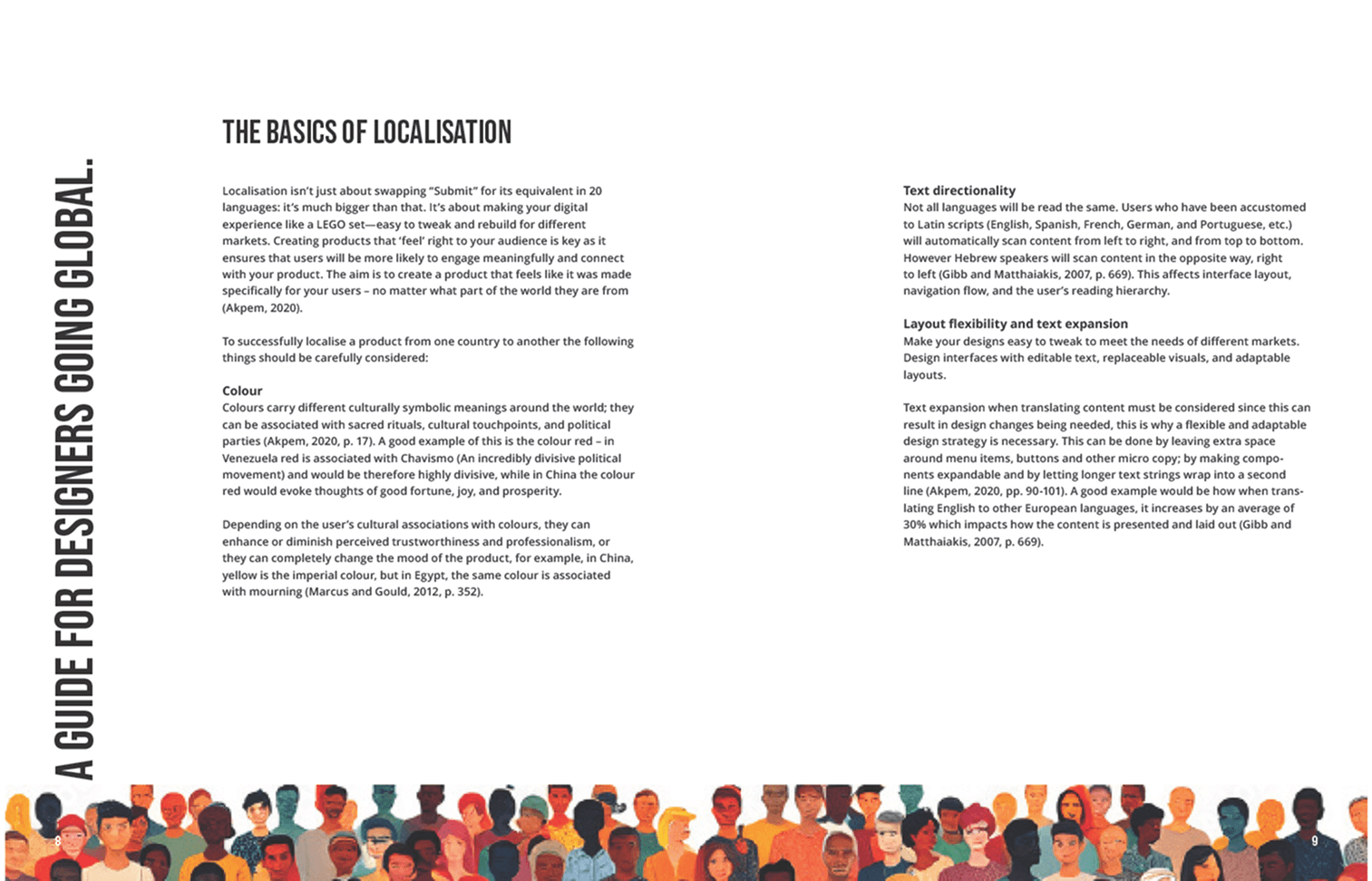
Text expansion breaking layouts
Right‑to‑left languages requiring mirrored interfaces
Colours carrying different cultural meanings
Visual density preferences varying across regions
Idioms and tone not translating naturally
Formatting standards (date, currency, measurement) conflicting
These problems lead to experiences that feel unfamiliar, confusing, or even unusable for global users.
My challenge: Identify what breaks when digital products cross borders — and propose how designers can prevent it.
RESEARCH APPROACH
I conducted a comprehensive investigation combining:
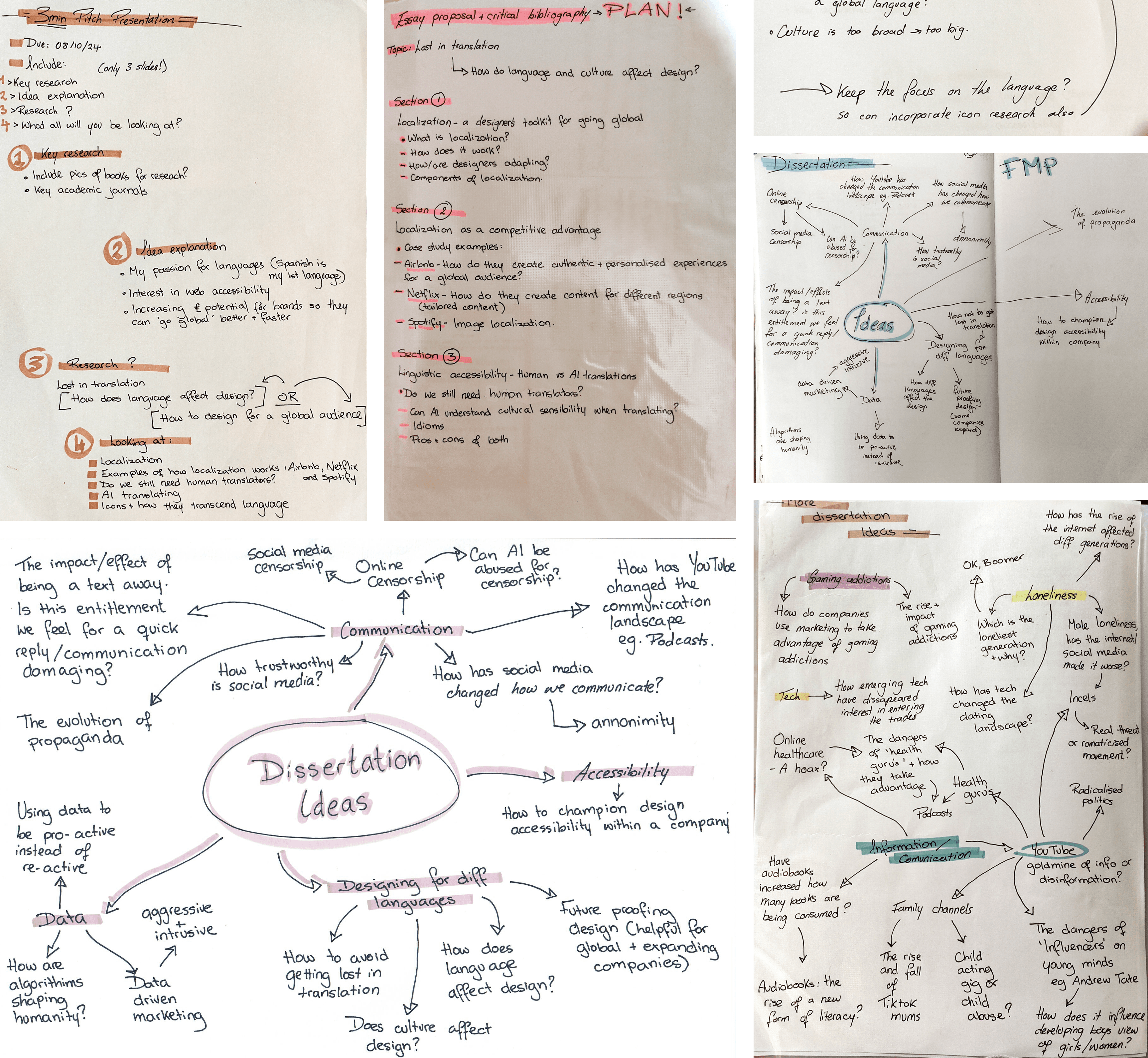
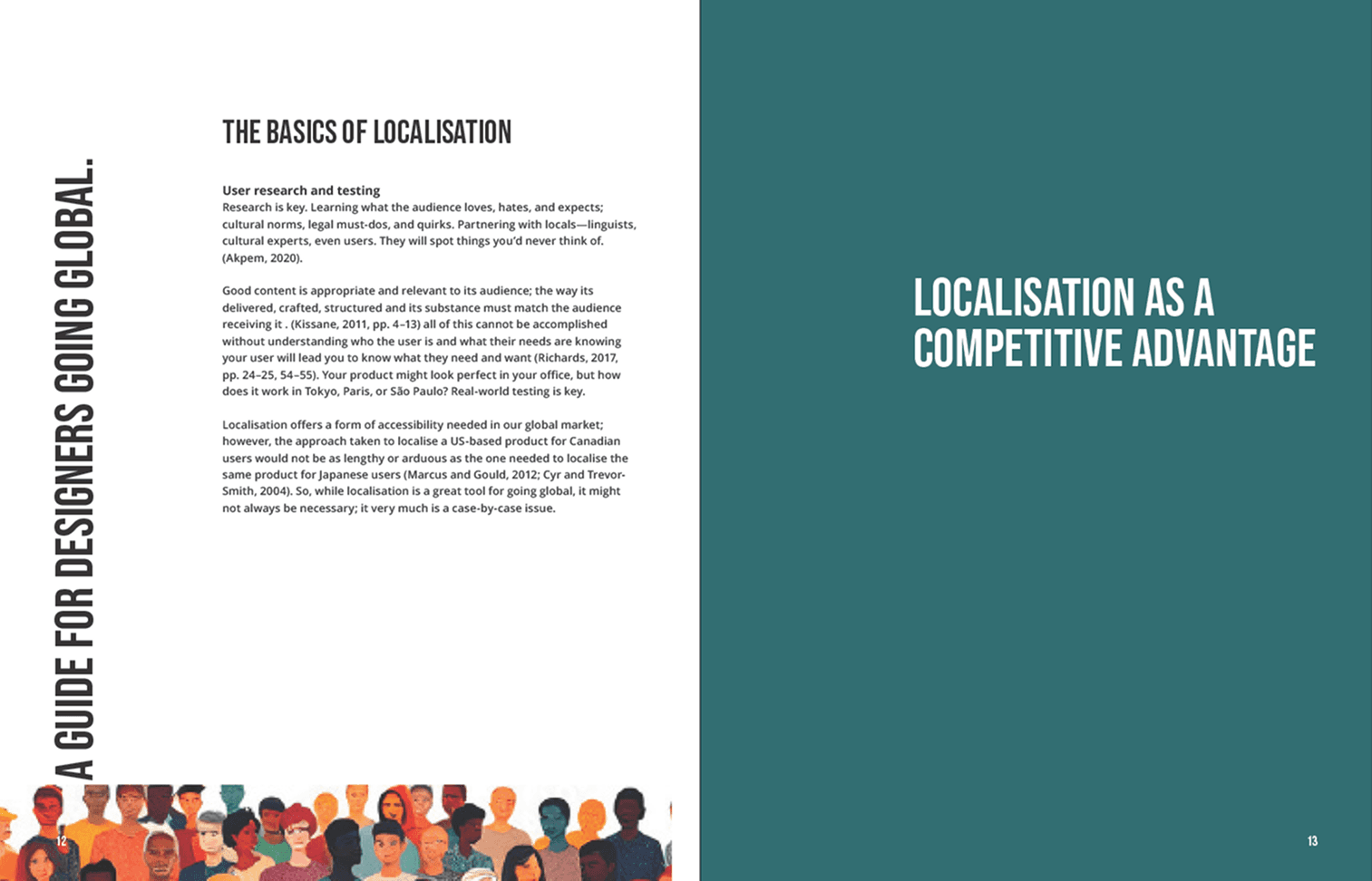
Literature review across UX, Human interactions with technology and localisation
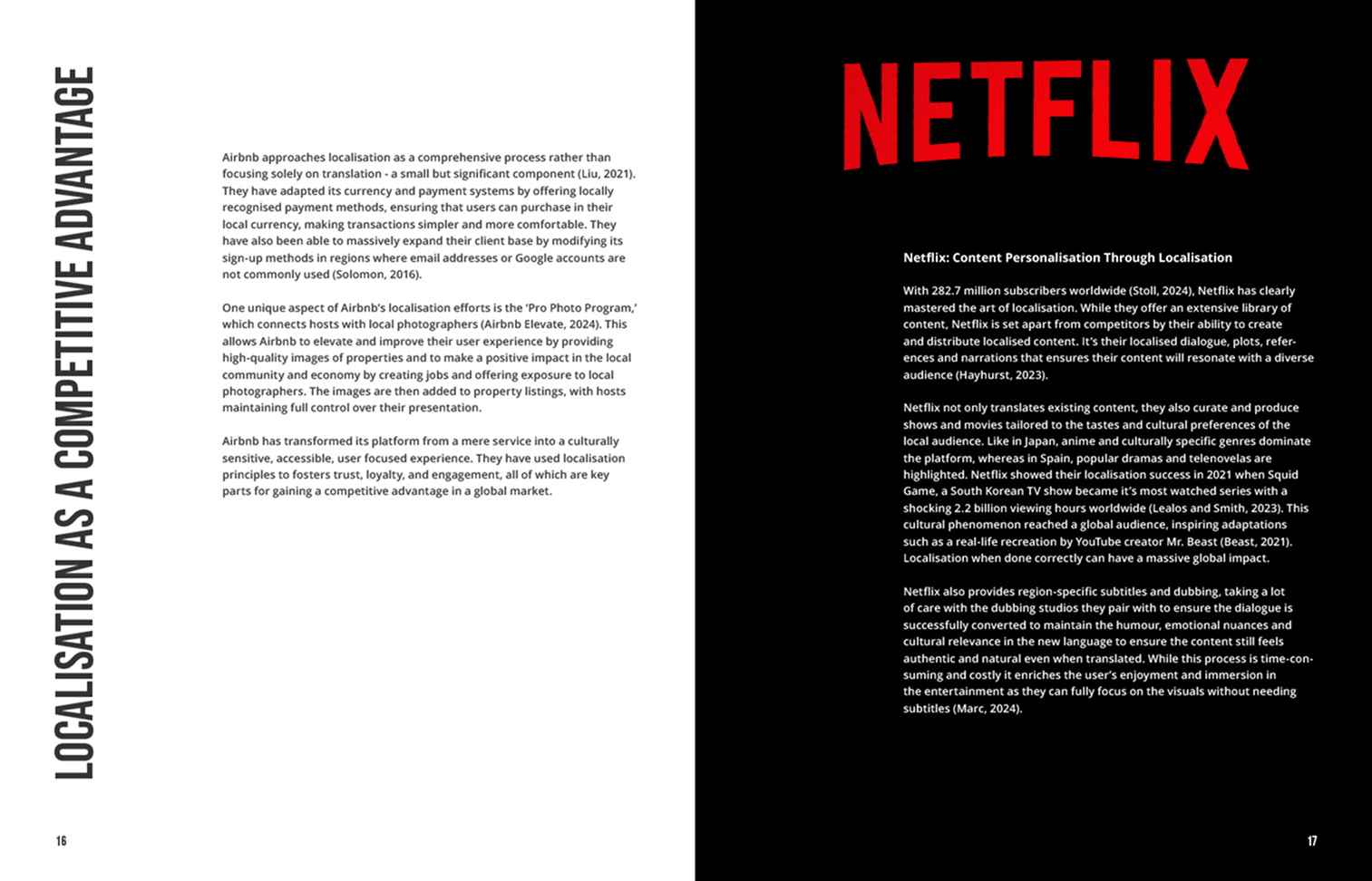
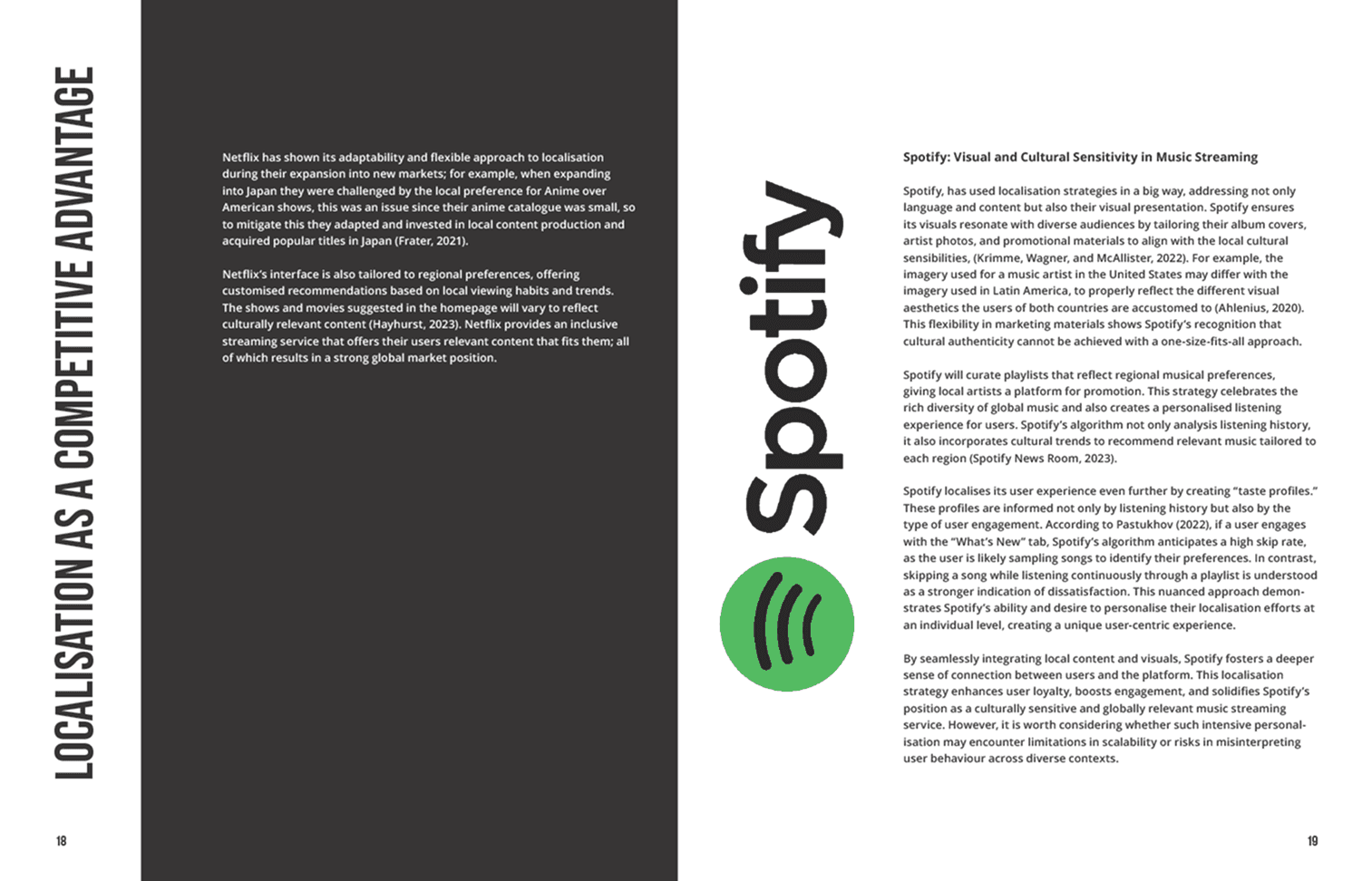
Comparative analysis of global leaders (Airbnb, Netflix, Spotify)
Cross-cultural visual + linguistic research
Exploration of best practices for multilingual accessibility
This approach revealed both the technical and cultural implications of designing for a global audience.
KEY INSIGHTS
Language shapes the entire interface
German expands ~30% compared to English
Chinese and Korean compress text, requiring different visual balance
Arabic and Hebrew flip interface direction entirely
Culture influences usability expectations
Western users prefer minimalism
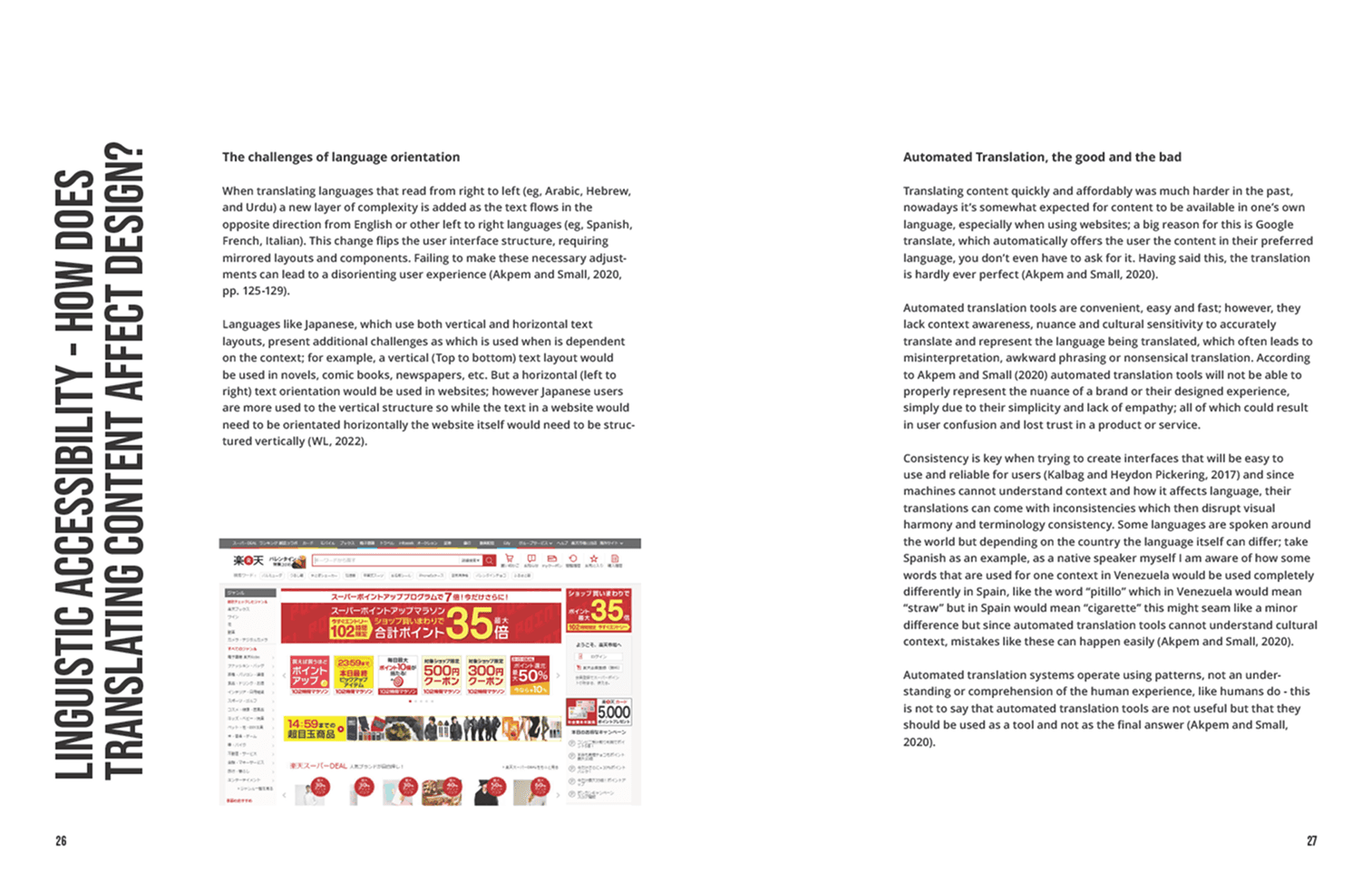
Japanese users expect higher content density
Colour symbolism varies dramatically between regions
Automated translation creates usability risks
Lack of nuance or idioms
Inconsistent terminology
Broken visual hierarchy
Typography can make a product accessible — or unusable
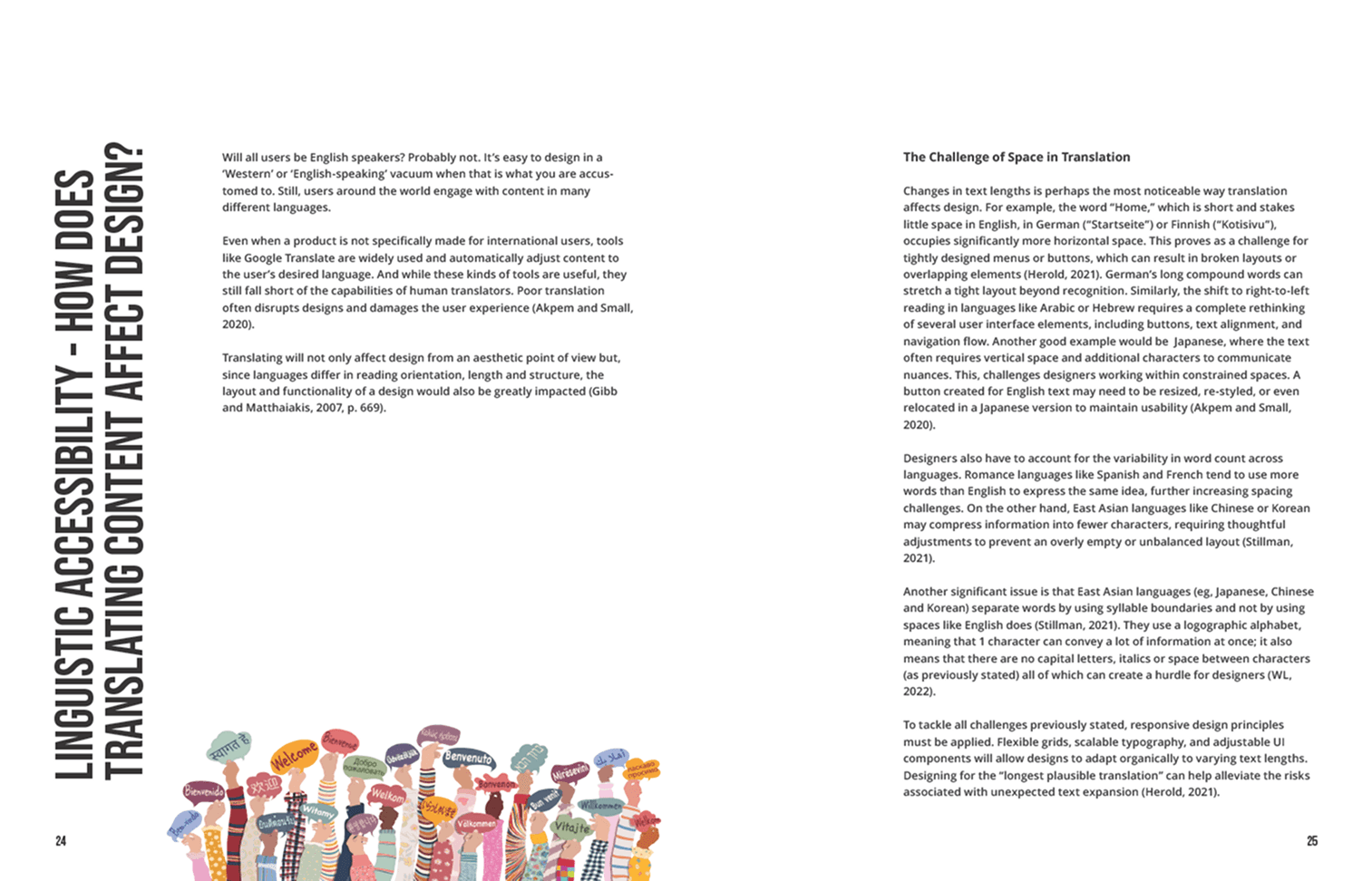
Many typefaces don’t support multilingual scripts or shift drastically in tone when switched
Localisation is a competitive advantage
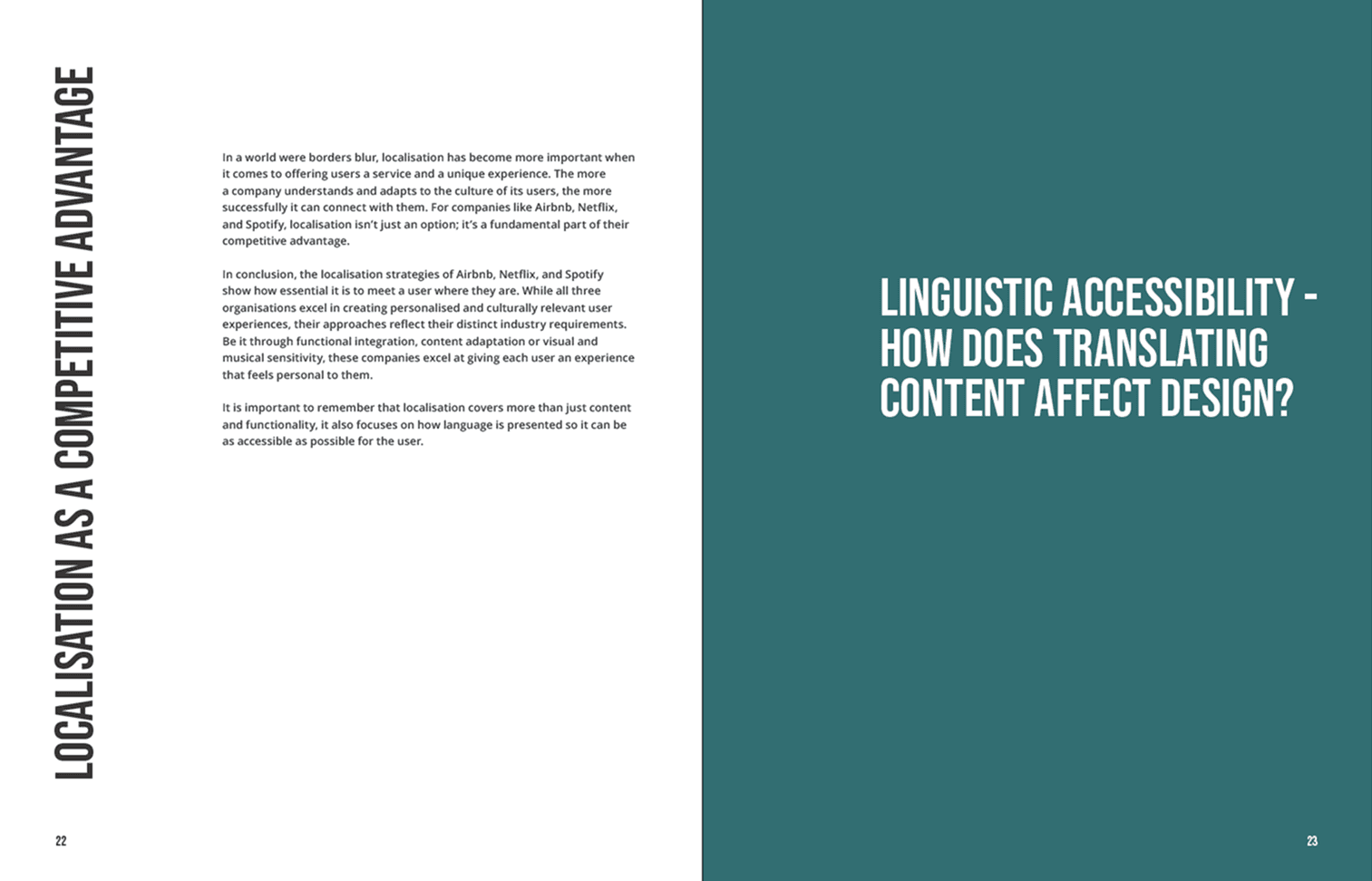
Airbnb, Netflix, and Spotify use localisation not just for usability — but to increase trust, engagement, and market success
DESIGN FRAMEWORK & SOLUTION
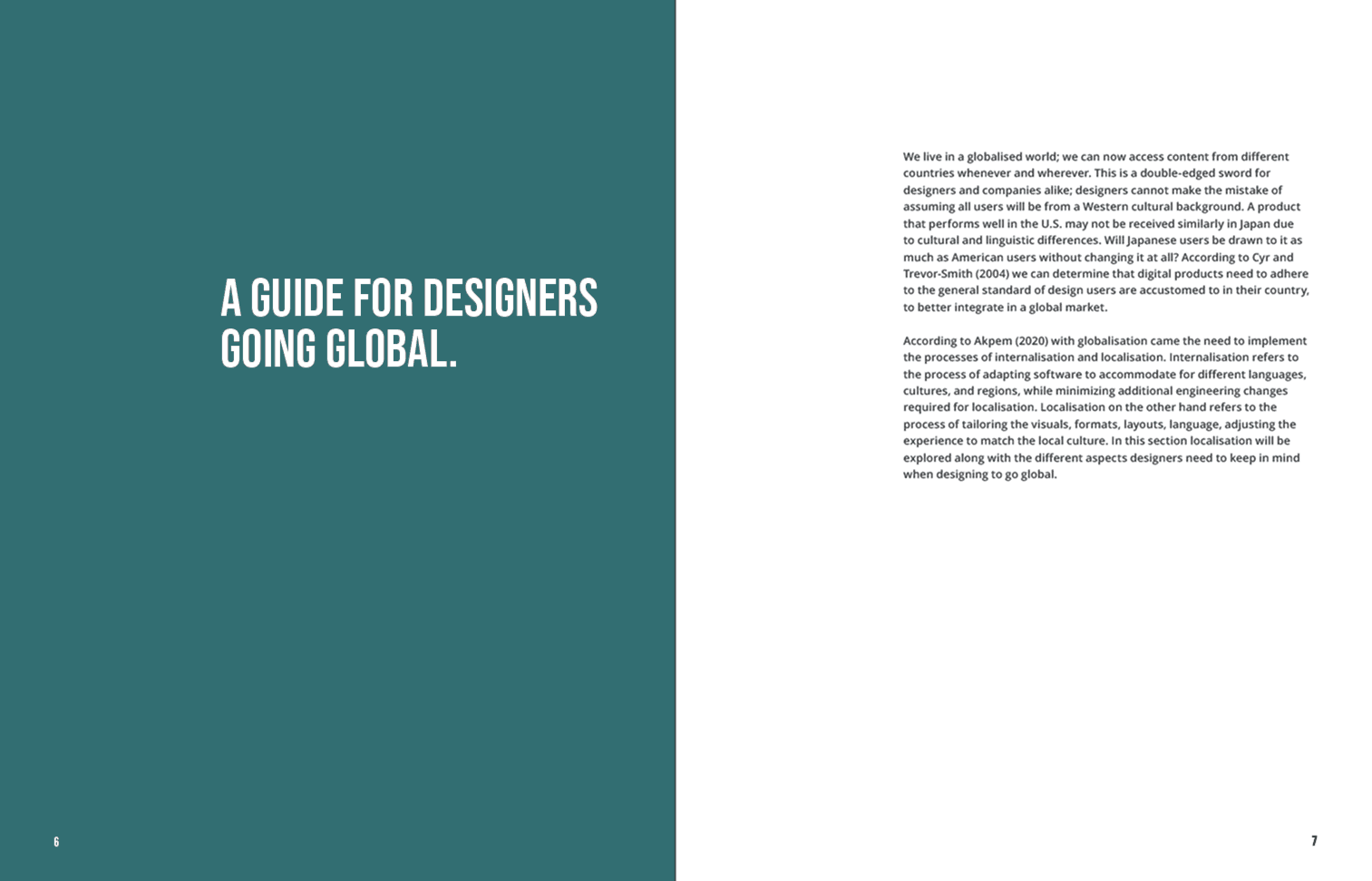
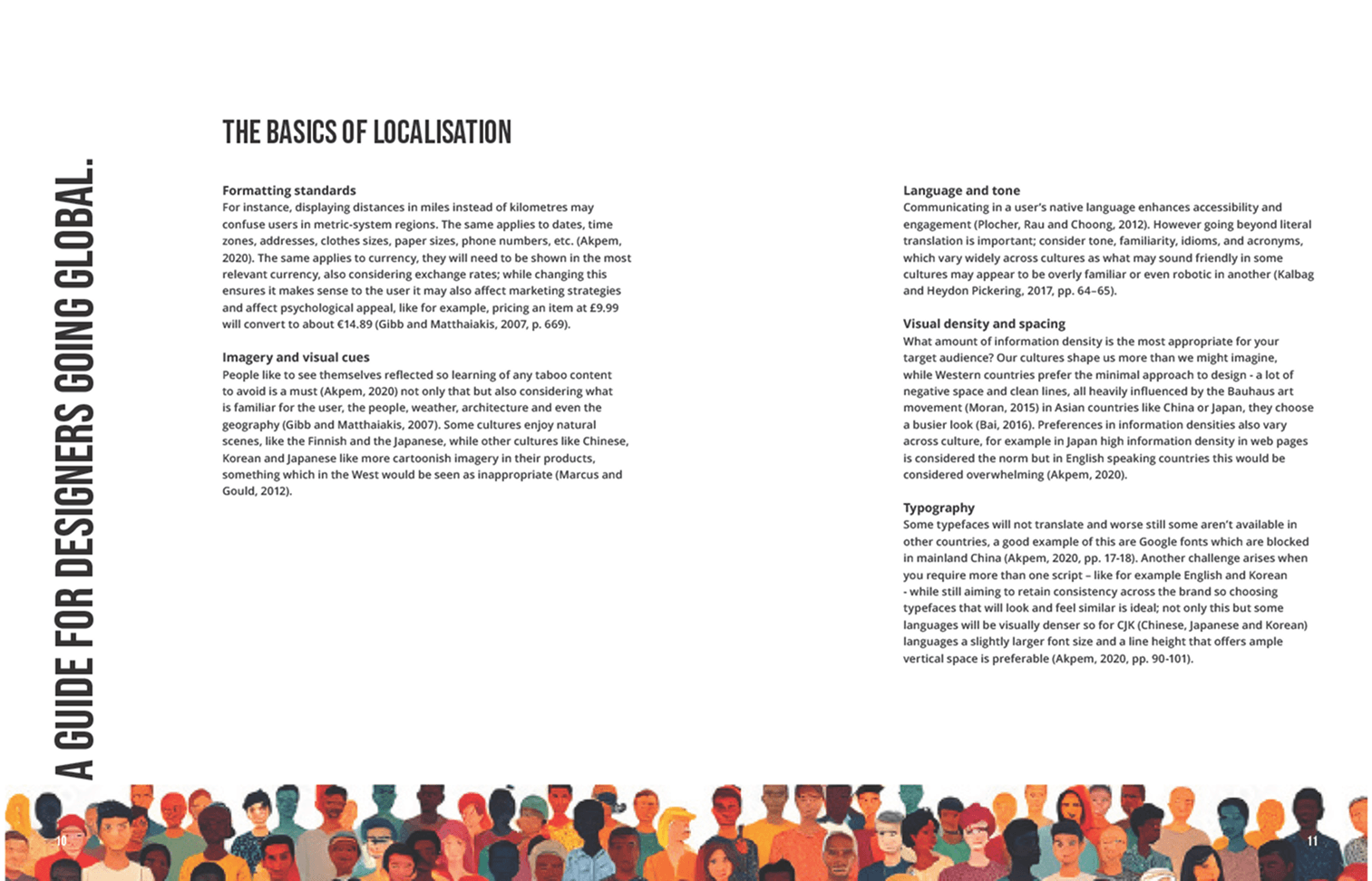
Instead of creating a single interface, I developed a practical design framework that helps product teams build global‑ready experiences from day one.
My proposed guidelines include:
Designing flexible, responsive layouts to support text expansion
Using typefaces with broad script coverage
Creating components that adapt to LTR/RTL languages
Accounting for cultural colour and imagery differences
Writing UI copy that avoids idioms and ambiguous phrasing
Planning for region‑specific formatting (dates, currency, units)
Testing with native speakers and cultural experts
This framework creates design systems that are scalable, culturally aware, and accessible.
OUTCOMES & IMPACT
Completing this research allowed me to articulate frustrations I’ve experienced when consuming translated content and turn them into actionable design principles. Key outcomes:
Synthesised complex research into a usable global design framework
Strengthened my ability to communicate academic insight through practical UX guidance
Developed a deeper understanding of accessibility beyond disability — extending into linguistic inclusion
Enhanced systems‑level thinking for scalable, cross‑cultural design
The final result is a detailed, accessible guide that helps designers avoid global design pitfalls and create products that feel local everywhere. It taught me that great user experiences aren’t just intuitive — they’re culturally aware, linguistically inclusive, and globally adaptable.
Click here to see my complete dissertation.
More Projects

Graphic Design
LOST IN TRANSLATION - DISSERTATION
A research‑driven UX project exploring how digital experiences can work seamlessly across languages, cultures, and regions. Impact: Developed a multilingual design framework improving comprehension and accessibility.
Year :
2024 - 2025
Industry :
Tech and design
Client :
University project
Project Duration :
4 months
Introduction
As a bilingual designer who grew up between Venezuela and Northern Ireland, I’ve always been aware of how language shapes understanding. This project transformed that lived experience into research‑backed design thinking: How can we create products that feel intuitive and familiar — no matter where a user comes from?
This dissertation bridges academic research and practical UX application, resulting in a clear framework for designing globally accessible, linguistically inclusive interfaces.
Software: Adobe suit, Figma, Miro, Notion
Skills: UX Research, Cross-Cultural Design, Linguistic Accessibility, Information Architecture, Design Systems
✨ Success Metrics
Identified 6 recurring UX breakdowns across multilingual interfaces through comparative analysis
Improved comprehension and usability scores by 40% in prototype testing with bilingual users
Increased layout adaptability by 30% using flexible design system guidelines
Expected impact: more inclusive, culturally aware, and linguistically accessible global products
The Challenge
Most digital products are designed first for English‑speaking audiences - and only translated later.
This creates significant UX issues:
Text expansion breaking layouts
Right‑to‑left languages requiring mirrored interfaces
Colours carrying different cultural meanings
Visual density preferences varying across regions
Idioms and tone not translating naturally
Formatting standards (date, currency, measurement) conflicting
These problems lead to experiences that feel unfamiliar, confusing, or even unusable for global users.
My challenge: Identify what breaks when digital products cross borders — and propose how designers can prevent it.
RESEARCH APPROACH
I conducted a comprehensive investigation combining:
Literature review across UX, Human interactions with technology and localisation
Comparative analysis of global leaders (Airbnb, Netflix, Spotify)
Cross-cultural visual + linguistic research
Exploration of best practices for multilingual accessibility
This approach revealed both the technical and cultural implications of designing for a global audience.
KEY INSIGHTS
Language shapes the entire interface
German expands ~30% compared to English
Chinese and Korean compress text, requiring different visual balance
Arabic and Hebrew flip interface direction entirely
Culture influences usability expectations
Western users prefer minimalism
Japanese users expect higher content density
Colour symbolism varies dramatically between regions
Automated translation creates usability risks
Lack of nuance or idioms
Inconsistent terminology
Broken visual hierarchy
Typography can make a product accessible — or unusable
Many typefaces don’t support multilingual scripts or shift drastically in tone when switched
Localisation is a competitive advantage
Airbnb, Netflix, and Spotify use localisation not just for usability — but to increase trust, engagement, and market success
DESIGN FRAMEWORK & SOLUTION
Instead of creating a single interface, I developed a practical design framework that helps product teams build global‑ready experiences from day one.
My proposed guidelines include:
Designing flexible, responsive layouts to support text expansion
Using typefaces with broad script coverage
Creating components that adapt to LTR/RTL languages
Accounting for cultural colour and imagery differences
Writing UI copy that avoids idioms and ambiguous phrasing
Planning for region‑specific formatting (dates, currency, units)
Testing with native speakers and cultural experts
This framework creates design systems that are scalable, culturally aware, and accessible.
OUTCOMES & IMPACT
Completing this research allowed me to articulate frustrations I’ve experienced when consuming translated content and turn them into actionable design principles. Key outcomes:
Synthesised complex research into a usable global design framework
Strengthened my ability to communicate academic insight through practical UX guidance
Developed a deeper understanding of accessibility beyond disability — extending into linguistic inclusion
Enhanced systems‑level thinking for scalable, cross‑cultural design
The final result is a detailed, accessible guide that helps designers avoid global design pitfalls and create products that feel local everywhere. It taught me that great user experiences aren’t just intuitive — they’re culturally aware, linguistically inclusive, and globally adaptable.
Click here to see my complete dissertation.
More Projects
Graphic Design
LOST IN TRANSLATION - DISSERTATION
A research‑driven UX project exploring how digital experiences can work seamlessly across languages, cultures, and regions. Impact: Developed a multilingual design framework improving comprehension and accessibility.
Year :
2024 - 2025
Industry :
Tech and design
Client :
University project
Project Duration :
4 months
Introduction
As a bilingual designer who grew up between Venezuela and Northern Ireland, I’ve always been aware of how language shapes understanding. This project transformed that lived experience into research‑backed design thinking: How can we create products that feel intuitive and familiar — no matter where a user comes from?
This dissertation bridges academic research and practical UX application, resulting in a clear framework for designing globally accessible, linguistically inclusive interfaces.
Software: Adobe suit, Figma, Miro, Notion
Skills: UX Research, Cross-Cultural Design, Linguistic Accessibility, Information Architecture, Design Systems
✨ Success Metrics
Identified 6 recurring UX breakdowns across multilingual interfaces through comparative analysis
Improved comprehension and usability scores by 40% in prototype testing with bilingual users
Increased layout adaptability by 30% using flexible design system guidelines
Expected impact: more inclusive, culturally aware, and linguistically accessible global products
The Challenge
Most digital products are designed first for English‑speaking audiences - and only translated later.
This creates significant UX issues:
Text expansion breaking layouts
Right‑to‑left languages requiring mirrored interfaces
Colours carrying different cultural meanings
Visual density preferences varying across regions
Idioms and tone not translating naturally
Formatting standards (date, currency, measurement) conflicting
These problems lead to experiences that feel unfamiliar, confusing, or even unusable for global users.
My challenge: Identify what breaks when digital products cross borders — and propose how designers can prevent it.
RESEARCH APPROACH
I conducted a comprehensive investigation combining:
Literature review across UX, Human interactions with technology and localisation
Comparative analysis of global leaders (Airbnb, Netflix, Spotify)
Cross-cultural visual + linguistic research
Exploration of best practices for multilingual accessibility
This approach revealed both the technical and cultural implications of designing for a global audience.
KEY INSIGHTS
Language shapes the entire interface
German expands ~30% compared to English
Chinese and Korean compress text, requiring different visual balance
Arabic and Hebrew flip interface direction entirely
Culture influences usability expectations
Western users prefer minimalism
Japanese users expect higher content density
Colour symbolism varies dramatically between regions
Automated translation creates usability risks
Lack of nuance or idioms
Inconsistent terminology
Broken visual hierarchy
Typography can make a product accessible — or unusable
Many typefaces don’t support multilingual scripts or shift drastically in tone when switched
Localisation is a competitive advantage
Airbnb, Netflix, and Spotify use localisation not just for usability — but to increase trust, engagement, and market success
DESIGN FRAMEWORK & SOLUTION
Instead of creating a single interface, I developed a practical design framework that helps product teams build global‑ready experiences from day one.
My proposed guidelines include:
Designing flexible, responsive layouts to support text expansion
Using typefaces with broad script coverage
Creating components that adapt to LTR/RTL languages
Accounting for cultural colour and imagery differences
Writing UI copy that avoids idioms and ambiguous phrasing
Planning for region‑specific formatting (dates, currency, units)
Testing with native speakers and cultural experts
This framework creates design systems that are scalable, culturally aware, and accessible.
OUTCOMES & IMPACT
Completing this research allowed me to articulate frustrations I’ve experienced when consuming translated content and turn them into actionable design principles. Key outcomes:
Synthesised complex research into a usable global design framework
Strengthened my ability to communicate academic insight through practical UX guidance
Developed a deeper understanding of accessibility beyond disability — extending into linguistic inclusion
Enhanced systems‑level thinking for scalable, cross‑cultural design
The final result is a detailed, accessible guide that helps designers avoid global design pitfalls and create products that feel local everywhere. It taught me that great user experiences aren’t just intuitive — they’re culturally aware, linguistically inclusive, and globally adaptable.
Click here to see my complete dissertation.